
The Dukes of Hazzard is a classic American action-comedy television series that aired on CBS from 1979 to 1985, following the high-spirited adventures of cousins Bo Duke and Luke Duke in the fictional rural Hazzard County, Georgia.
While the core genre of the series is considered to be action comedy, some fans informally call it a contemporary Western due to outlaw heroes vs. corrupt authority and rural setting, combined with chase sequences standing in for horseback pursuits. Is it a Western? We will dive into that discussion in this article.
Car Chases and Southern Comedy
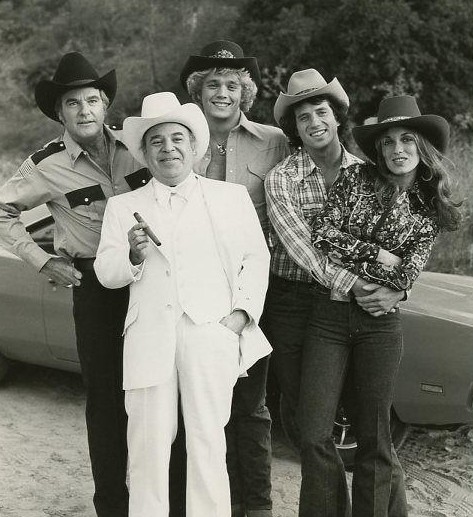
The Dukes of Hazzard blended high-energy car chases and physical comedy with lighthearted, formulaic storytelling and is generally classified as a “rural comedy” or “Southern action comedy” in retrospectives. It revived vibes from earlier rural sitcoms like The Beverly Hillbillies but with more emphasis on escapist adventure and slapstick. Aimed at broad family audiences, the series focused on fun, rebellious “good ol’ boy” antics rather than deep drama.
The series focused on the antics and exploits of two country cousins, Bo and Luke Duke, who live on a small family farm with their beautiful cousin Daisy Duke and their wise, no-nonsense patriarch Uncle Jesse. Having previously run moonshine, Bo and Luke are now on probation, which bars them from carrying firearms or leaving the county without permission—conditions they frequently bend while using bows, arrows, and quick wits instead. Their primary mode of escape and excitement is the iconic orange 1969 Dodge Charger nicknamed the General Lee, which they pilot through daring jumps and chases across dirt roads and fields.
Fightin’ the System Like Two Modern Day Robin Hoods
Each episode typically pits the fun-loving, good-hearted Dukes against the corrupt local power structure, led by the greedy county commissioner Jefferson Davis “Boss” Hogg and his dim-witted, often incompetent sheriff Rosco P. Coltrane. The Dukes constantly outmaneuver schemes involving crooked deals, out-of-town crooks, or threats to the community, all while helping friends, protecting the innocent, and staying one step ahead of the law. Blending slapstick humor, over-the-top car stunts, Southern charm, and a lighthearted outlaw spirit, the show became a cultural phenomenon, celebrated for its escapist fun and the rebellious yet moral “good ol’ boys” at its core.
But is it a Western?
Fans informally call the series a contemporary Western due to outlaw heroes vs. corrupt authority and rural setting, combined with chase sequences standing in for horseback pursuits.
No major film scholars, critics, or genre discussions classify it as a Western, or even a contemporary Western. Official classifications list it primarily as action comedy, adventure comedy, or buddy comedy, with influences from 1970s car-chase films like Smokey and the Bandit (which itself has Western echoes). Wikipedia and major sources don’t tag it strictly as a Western, but user-added keywords on IMDb include “contemporary Western,” “modern Western,” and “neo-Western.”
The show transplants many classic Western archetypes into a late-1970s/early-1980s rural Southern setting:
- Outlaw heroes vs. corrupt authority — The Duke boys are good-hearted moonshiners (essentially modern outlaws) constantly outwitting a crooked county commissioner (Boss Hogg) and his bumbling sheriff (Rosco), much like frontier outlaws evading greedy landowners or crooked lawmen in traditional Westerns.
- The “law” as the villain — The theme song and narration (by Waylon Jennings) explicitly frame them as “modern-day Robin Hoods” fighting “the system,” echoing outlaw ballads and Western tales where the law is often the oppressor.
- Car chases as horse pursuits — Fans frequently point out that the high-flying General Lee jumps replace horseback chases or stagecoach robberies — one common fan line is “just sub cars for horses.”
- Action scenes as gun fights — (nearly?) every episode incorporates non-violent (but chaotic) action standing in for the classic Western gunfight.
- Rural frontier vibe — Hazzard County feels like a small, isolated town with a corrupt power structure, family loyalty, and outsiders (“city slickers”) causing trouble, paralleling frontier towns.
- Lighthearted tone — Like many classic B-Westerns (Roy Rogers, Gene Autry), it’s escapist, formulaic fun with no real stakes, slapstick violence, and clear good-vs-evil morality — not the darker tone of revisionist Westerns.
Some episodes lean even harder into the comparison — like “Go West, Young Dukes,” which directly plays with Western tropes (old deeds, land disputes). Creator Gy Waldron drew from his Kentucky roots and bootlegging stories, but the show’s structure mirrors old Western serials updated for TV with muscle cars instead of six-shooters.
While user-added keywords on IMDb include “contemporary Western,” “modern Western,” and “neo-Western”, one would be hard-pressed to list it as a neo-Western. The neo-Western proper incorporates revisionist themes, which The Dukes does not have.
The revisionist Western themes subvert the myths of the traditional Western. Traditional Westerns often feature clear moral heroes (like the lone gunslinger upholding justice), romanticized frontier life, and a simplistic good-vs-evil narrative set in the historical American Old West. Revisionist ones, emerging prominently from the late 1960s onward (e.g., The Wild Bunch, Unforgiven, or Dead Man), introduce moral ambiguity, graphic realism, critiques of violence, colonialism, or heroism, and often deconstruct those classic tropes with darker, more cynical, or psychologically complex portrayals. These elements would be present in the neo-Western genre. The Dukes is too upbeat, formulaic, and non-subversive for that label.
Although it’s not a “pure” Western (no historical Old West setting, no guns due to probation, heavy comedy focus), it is definitely a Southern-fried contemporary take on Western formulas — independent rebels protecting their way of life against corrupt local power — the label fits well enough that plenty of people use it. If you’re from the rural South, it probably feels even more like a hometown Western fantasy.